
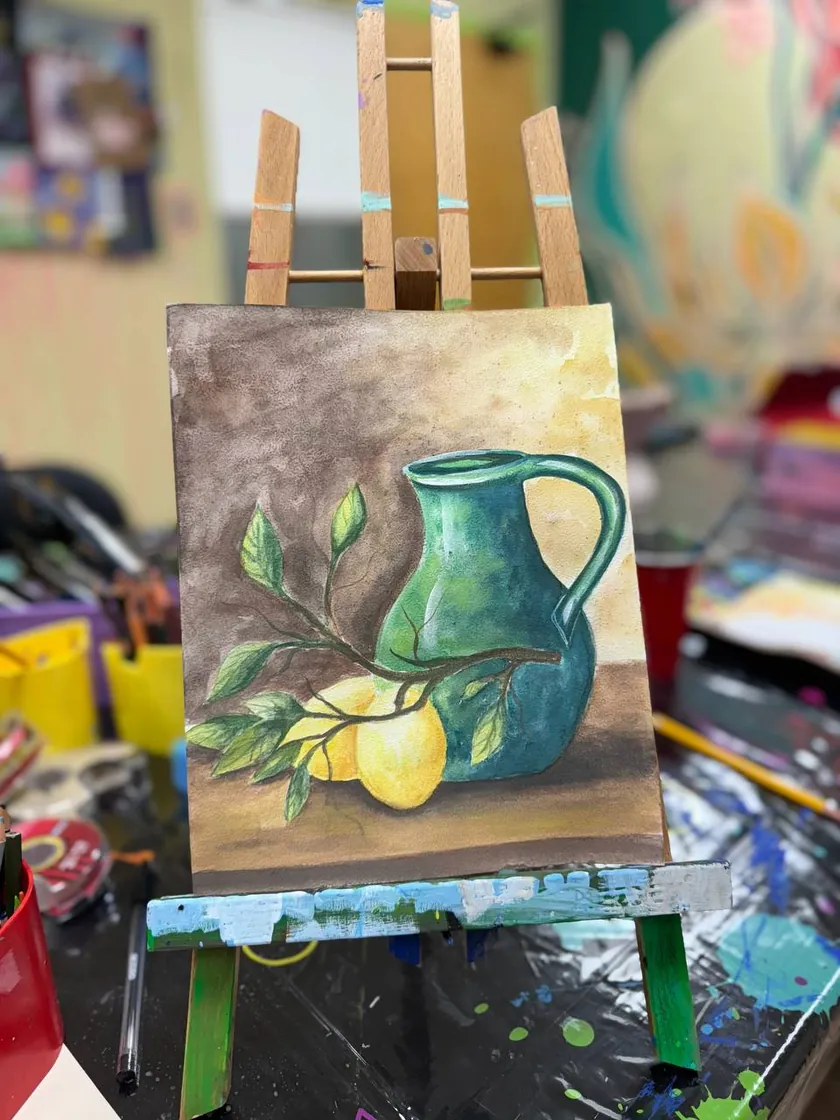
The short answer
For most beginners, acrylic is easier to get a good result with, and watercolour is the better teacher of control. A child who starts with acrylic gets a finished painting they are proud of quickly. A child who also does watercolour learns to plan, to leave white space, and to work with the paint instead of against it. That is why good painting classes teach both rather than picking one.
How watercolour and acrylic differ
| What matters | Watercolour | Acrylic |
|---|---|---|
| Look | Transparent, soft and glowing | Opaque, bold and bright |
| Drying | Stays workable, and dried paint can be re-wet | Dries in minutes and becomes water-resistant |
| Mistakes | Hard to cover, since light colours cannot sit on top of dark ones | Easy to paint over once dry |
| Order of work | Light to dark, with the paper as the white | Any order, including light over dark |
| Surface | Heavy watercolour paper | Canvas, canvas board or heavy paper |
| Clean-up | Washes out of brushes and most fabrics | Wash brushes before the paint dries. Dried paint stays on clothes |
Why acrylic suits most beginners
Acrylic forgives. If a sky goes wrong, a child can let it dry for a few minutes and paint a new one over it. The colours stay bright, the paint sits where it is put, and a first canvas painting usually looks like what the child meant it to look like. For a beginner, that early success is what keeps them coming back.
The catch is speed. Acrylic dries quickly on the palette and on the brush, so children learn to mix small amounts, keep brushes wet, and wash them straight after use.
What watercolour teaches that acrylic does not
Watercolour is harder, and that is its value. Because light colours cannot go on top of dark ones, a child has to decide where the highlights are before starting and paint around them. They learn to control how much water is on the brush, to wait for one layer to dry before the next, and to let the paint do some of the work.
Those habits, planning, patience and control, carry straight into drawing, acrylic and digital art. Children who only ever use opaque paint can miss them.
Is there a right age to start?
No. Children as young as 4 can enjoy both paints with the right projects. What changes with age is the goal. Younger children are exploring colour, mixing and brush control, so loose watercolour washes and simple acrylic shapes both work well. From about 8 or 9, many children start wanting their paintings to look realistic, and that is when the technique of each paint starts to matter: layering and blending in acrylic, and planned washes and wet-on-wet effects in watercolour.
What to buy if you want to paint at home
- Student-grade paint. Artist-grade paint is not needed to start. Look for the AP seal from the Art & Creative Materials Institute, which marks a product as non-toxic.
- Proper paper for watercolour. Heavy watercolour paper (around 300 gsm, or 140 lb) buckles far less than printer or sketchbook paper.
- Canvas boards for acrylic. They cost less than stretched canvas and are fine for practice.
- A few good brushes. One round brush and one flat brush in a medium size cover most beginner projects.
- An old shirt. Especially for acrylic.
How we teach painting in class
Our drawing and painting classes in Richmond Hill cover watercolour, acrylic and mixed media, along with drawing fundamentals, colour theory and composition. Students are grouped by age and skill, from about age 4 through the teen years, and all materials, including paint, paper and canvas, are provided. A one-hour beginner class is $25 + HST and a two-hour intermediate or advanced class is $48 + HST per session. An art supplies fee of $185 + HST applies.
Try a painting class
Book a free trial class so your child can meet our teachers and try a class before you register.