
How do you tell a good art class from a nice one?
Most families choose a children’s art class on atmosphere. A bright room, a warm teacher, and a child who comes home holding something. That is a perfectly reasonable way to choose at five. It stops being reasonable around nine, and by thirteen it can quietly cost a child a place in a program they wanted.
The useful part is that you do not have to guess what a serious art education looks like, because Ontario’s arts programs publish exactly what they assess. We went through the published requirements for Arts Unionville, Arts Mackenzie, OCAD University, Sheridan College and York University’s AMPD. They agree with each other to a degree that surprised us, and what they agree on works as a checklist years before anyone applies to anything. The full breakdown of those requirements is in our York Region portfolio guide.
1. Does the child draw from life, or from a screen?
Sheridan’s Bachelor of Illustration scores applicants on a drawing test worth 70% of the assessment, with the portfolio of finished artwork worth only 30%. The test asks for ten observational drawings from life, a thirty-minute sketch of a seated person, and a still life built from ordinary kitchen objects. The program states that every drawing must be observational drawing from life, and it prohibits AI-generated imagery, photo-derived work and grid transfers.
Arts Unionville goes further and tests it live: applicants sit an on-site workshop that includes gesture drawings from a model, with no preparation time at all.
So the first question to ask about any class is simple. Does the child ever draw an actual object placed in front of them? A great deal of children’s art instruction is copying from a printed reference or following the teacher’s example on a screen. That produces attractive results quickly, and it builds almost none of the skill these programs are measuring.
2. Is there a sketchbook that leaves the classroom?
Every single program we looked at asks for one:
- Arts Unionville lists sketchbooks as a required portfolio component.
- York University counts a current sketchbook as one of the eight works submitted.
- OCAD University requires process work alongside finished pieces.
- Sheridan College asks for 15 to 25 sketchbook pages.
This is the one thing that cannot be produced on a deadline. Finished pieces can be made in a few months. A sketchbook showing sustained practice is, by definition, evidence of time spent, and an admissions panel can tell the difference immediately.
Ask whether the class involves a sketchbook the child keeps and works in between sessions. If the only output is finished pieces that come home and go on the fridge, nothing is accumulating.
3. Does the work change as the child gets older?
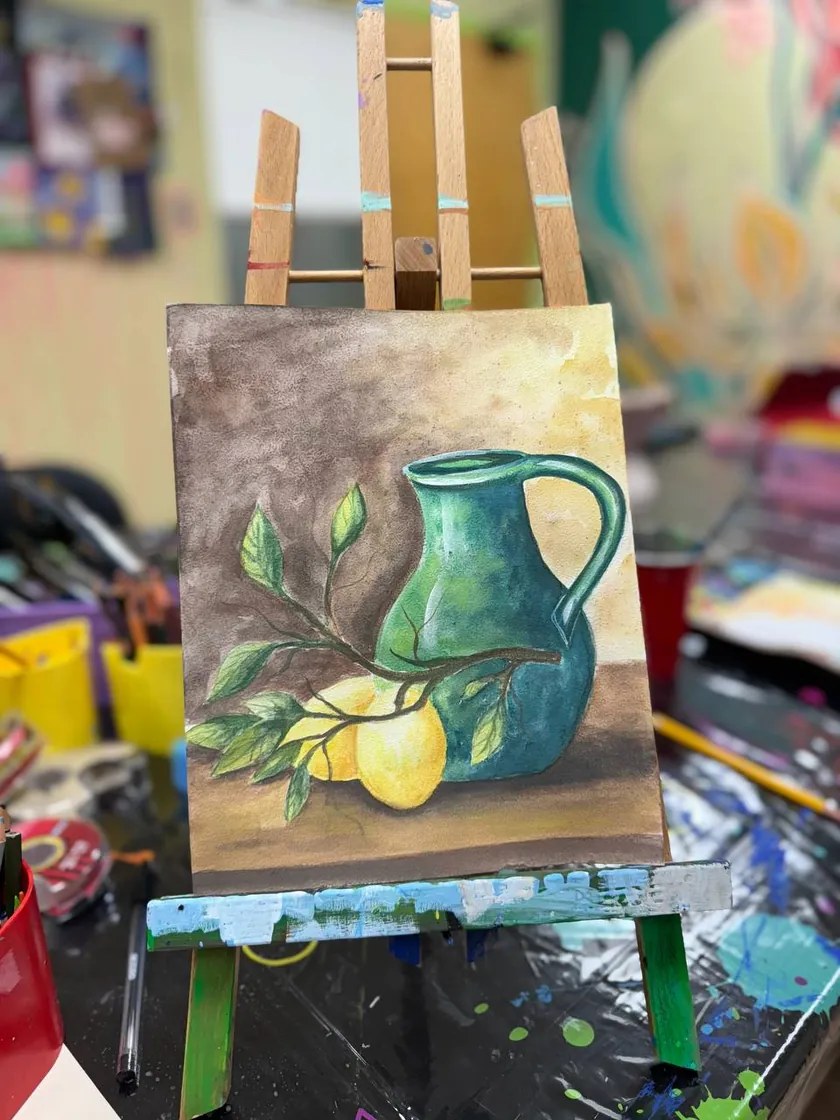
Guided group projects, where everyone paints the same subject and leaves with their own version of it, are genuinely good for young children. They build confidence, they teach process, and a five year old needs the win at the end of the hour. We run them, and we would defend them.
The question is what replaces them. At nine a child should be making their own decisions about composition. At twelve they should be carrying one piece across several weeks. At fifteen they should be building a body of work with some coherence to it.
So ask directly: what does a twelve year old do here that an eight year old does not? If the answer is the same projects with more difficulty added, that is a class a child will outgrow without anyone noticing. Our own answer is three routes through the school, a Creative Path for children exploring art as a hobby, a Professional Path of longer sessions for students working on technique seriously, and a Portfolio Path of private lessons for teens preparing an application.
4. Is there enough time in one sitting?
One hour is enough to make something. It is not enough to look at something carefully, get it wrong, and fix it, which is most of what learning to draw actually consists of.
This is why the assessment tests are timed the way they are. Sheridan asks for five quick sketches under ten minutes and five sustained drawings of ten to thirty minutes, because working fast and working slowly are two separate skills and a portfolio has to show both.
For a young child, one hour is right, and a longer session is counterproductive. Once a child is genuinely interested, look for the option to move up. We run classes at both one hour and two hours for exactly this reason, and a school that offers only one length is a ceiling you will eventually hit.
5. Do the materials behave like real materials?
Student-grade paint carries less pigment and more filler. It dries differently, it does not blend the same way, and a child learning colour mixing on it is learning something slightly false that has to be unlearned later.
This matters less than the four points above, and it is the one most schools lead with, which is worth noticing in itself. But if a child is going to spend years on this, materials that respond properly are not a luxury.
Ask what is provided and whether it is included in the fee. Materials charged per project tend to get rationed, and rationed materials mean less experimentation, which is the opposite of what a class is for.
The five questions, in one place
What to ask on the phone or at a trial class
- Does my child ever draw from a real object placed in front of them?
- Is there a sketchbook they keep and work in between classes?
- What does a twelve year old do here that an eight year old does not?
- Is there an option for a longer session as they progress?
- What materials are provided, and are they included in the fee?
You can ask all five in a single phone call or during one trial class, and the answers will separate schools faster than any amount of looking at photographs of finished student work. Finished work tells you what a teacher can get out of a child in one session. It tells you very little about what the child can do on their own, which is the only thing an admissions panel is ever measuring.
How we answer them
| Question | At Oxford Art Academy |
|---|---|
| Drawing from life | Still life, observational studies and work from real objects sit alongside guided projects, increasing with age and level |
| Sketchbook | Part of the Professional and Portfolio routes, where sustained practice is the point |
| A path that changes | Creative, Professional and Portfolio routes, from age 4 through art school applications |
| Session length | One hour and two hour classes, seven days a week |
| Materials | Included in class. Annual art supplies fee of $185 + HST. iPads with Apple Pencil and Procreate provided for digital work |
Current per-session rates and term details are on the programs page. If you are at the very beginning and none of this is relevant yet, our beginner’s guide to kids’ art classes is the better starting point.
Serving Richmond Hill and York Region
Our school is at 14 Oxford St, Unit 201C, Richmond Hill, ON L4C 9S3. We welcome families from across York Region, including Thornhill, Vaughan, Markham, Aurora and Newmarket, to drawing and painting, digital art and combo classes, plus seasonal camps and art birthday parties.
Try a class first
Bring the five questions with you. Book a free trial class and ask us all of them, then ask the next school on your list the same ones.